TvF Consulting · Warsaw · all of Poland
Every number has a source
the other side can verify
Business valuation, financial analysis and AI-assisted management reporting
I value businesses, break profitability down to its drivers and build tools that read financial statements automatically. I work from source data — statements filed with the commercial register, ledgers, time records — not from materials prepared by the seller. For owners, boards and investors — in Warsaw and across Poland.

Tomasz Fordymacki
Financial adviser · valuation, transaction analytics, management reporting
- A model, not a slide deck — you get a file that calculates
- Three valuation methods reconciled into one number
- Confidentiality from the first phone call
Tomasz Fordymacki
Financial adviser · valuation, transaction analytics, management reporting
8
financial analyses
one engine, eight companies, the same method
7
valuation models
income, market and asset approach in each
11
applications and tools
built from scratch, some of them public
335
scripts
they do the repetitive work so I can do the rest
Expertise
Five things I do well
This is not a list of everything I can do — it is a list of what is worth coming to me for.
How I work
Four steps, always the same
The order is not accidental. The most expensive mistakes come from skipping the first step.
Source data
- 01
Source data
Register filings in machine-readable form, a ledger export, time records, contracts. Not summaries prepared to support a thesis. If data is missing, I say so at the start rather than in the conclusions.
- 02
Normalisation
One-off events, related-party transactions, owner’s remuneration, costs unrelated to the business. Every adjustment has a number, an amount and a justification — so each one can be argued separately.
- 03
The model
The numbers are calculated in the file, not in my head. Changing an assumption recalculates the whole model, and closing checks make sure the balance sheet ties and the cash flow reconciles to zero.
- 04
The document
At the end there is something you can put on the table: a workbook, a report and a presentation stating the same number. Three documents that contradict each other are worse than none.
AI and automation
Machines do the counting, a person answers for it
I use language models and my own scripts where the work consists of reading documents and retyping numbers. Decisions on adjustments, weights and the conclusion stay with me — and are documented so they can be checked.
Reads
Registry filings in XML, ledger exports, time records — loaded and reconciled automatically, a dozen companies with one method.
Checks
Around a hundred ledger-control rules and several hundred tests that catch errors before they reach the report. A document that checks itself.
Reports
Dashboard, report and presentation generated from one model, in Polish and French — the same number everywhere, no retyping.
What I never hand to the model
Normalisation adjustments, valuation method weights, forecast assumptions and the final conclusion. The model speeds up reading and computing; responsibility for the number on the table is mine.
Glossary
Speaking the same language
Half the misunderstandings at the table come from two sides reading the same word differently. These are ten terms that come up in every conversation about value — with a definition and with the mistake most often made around them.
Common mistake
Comparing one company’s enterprise value with another’s share price. These are two different numbers and they differ by net debt.
Common mistake
Treating EBITDA as cash flow. It ignores working capital, capital expenditure and tax — a company with positive EBITDA can still fail.
Common mistake
Treating the whole cash balance as surplus. Part of it is working capital the business needs to operate and cannot be taken out.
Common mistake
Ignoring it while growing. Rising sales always consume cash through working capital — the main reason growing companies fail.
Common mistake
Taking the weights from the current book balance sheet rather than from target values. The valuation then depends on an accidental year-end position.
Common mistake
Underestimating its weight. It is usually 60–80% of the whole valuation, so a small change in the growth assumption moves the result more than the entire forecast.
Common mistake
An adjustment without evidence. The seller always normalises upwards and the buyer downwards — a document settles it, not a statement.
Common mistake
Reaching for listed-company multiples for a small private business. Indicative ranges for Polish SMEs in 2025–2026 are 3–6× for small and 5–8× for mid-sized companies — depending on sector, growth and data quality.
Common mistake
Skipping the test. Healthy companies keep conversion above 70–80%; a persistently lower figure means the profit is sitting in receivables.
Common mistake
Reading the ratio without context. In Polish banking practice (2025–2026) comfortable lending reaches about 3.0×; above 4.0× the conversation is about restructuring, not growth.
Projects
What has passed through my hands
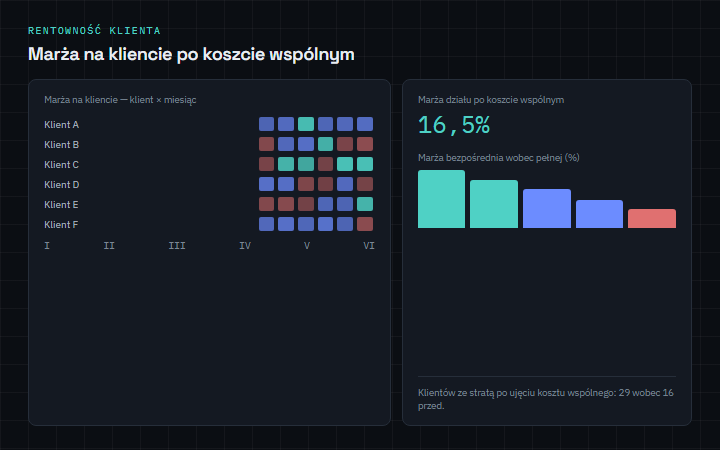
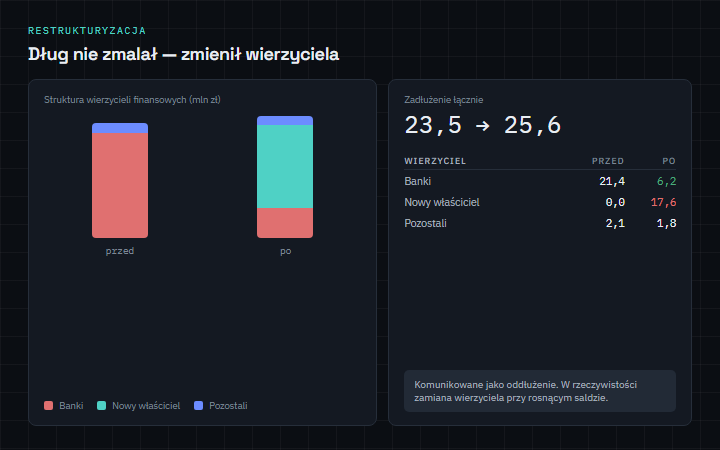
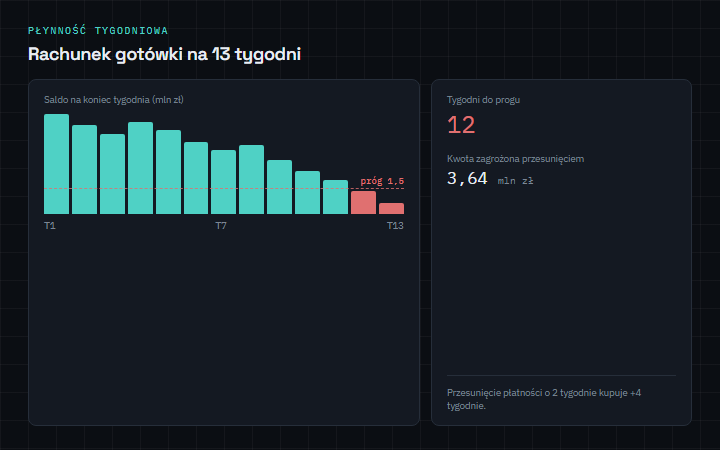
Client work is described without names and without figures that would allow identification — industry, problem, approach, result. My own projects are named, because they are mine.
Tool
Estimate what your company is worth
The same scheme I start every valuation with: a discounted forecast and a market approach, reconciled by weights, ending with a bridge from enterprise value to equity value. The result is indicative and does not replace a valuation.
Equity value
16,9m
Sensitivity to cost of capital ±1 pp: 15,9 – 18,1 m
- Income approach
- 19,5 m
- Market approach
- 18,0 m
- Enterprise value
- 18,9 m
- Bridge to equity value
- −2,0 m
The model discounts a cash flow calculated as EBITDA after tax less maintenance capital expenditure and the increase in working capital (assumed at 4% of revenue). The result is an estimate based on seven numbers — a real valuation requires normalising the result, reviewing contracts and checking source data.
I want this calculated properlyFrom method to equity value
Where the figure on the right comes from. Every step can be challenged on its own, which is the point.
Materials
Downloads
Short method notes — one page per topic. They set out how I calculate, so it can be checked before a conversation rather than after it.
Questions
Before you write
Six questions that come up in the first conversation — and the answers I usually give.
How does an engagement start?
A short conversation about the problem (no commitment), then a list of the data I need and a scope proposal with a deadline. Work starts once the scope is accepted — there is no “valuation of the valuation” stage.
How long does a valuation or analysis take?
Valuation: two to four weeks from complete data. A thirteen-week cash ledger: a few days. Profitability analysis with segment accounts: two to three weeks, depending on ledger quality. Most of the time goes to questions about data, not to computing.
What data do you need?
Financial statements (ideally XML files from the registry), a trial balance, a ledger export for the period, material contracts and debt information. For profitability — also time records or cost allocation keys. If something is missing, I say so at the start.
What about confidentiality?
An NDA before the first file, data stored locally and encrypted, no client names on this site or in materials. Portfolio descriptions are anonymised: sector, problem, effect.
Who computes and who answers for it?
Tools compute — scripts, models, partly language models. I answer: for adjustments, assumptions and the conclusion. Every number in a document has a source the other side can check, and that is a rule I do not depart from.
Do you work remotely and outside Warsaw?
Yes — most of the work happens on data, not in the client’s office. Meetings in Warsaw or online; for clients across Poland and for companies with foreign capital (in English, in French at a working level).
Have a concrete problem with the numbers?
Write two sentences about what it is. I will tell you whether it is my kind of work and roughly how long it takes.